Showing posts with label Past Tenses. Show all posts

Monday, June 20, 2011

Past Continuous (Past Tenses)

EXAMPLE:
  • What were you doing then?
  • I was eating the dinner when someone knocked at the door.
  • When he was sleeping, I was working hard
  • I was wondering if you could help me.
We usually use The Past Continuous (Progressive) to talk about longer actions in progress in the past. The actions can be interruped by something ("He was reading when she arrived") or can be happening at the same some ("She was learning English when he was watching TV"). There are also two other uses.

USE :
  1. Actions in progress (in the past)
  2. Interrupted actions in progress (in the past)
  3. Actions in progress at the same time (in the past).
  4. Irritation over something or somebody (in the past)
  5. Timid / polite question
USE 1: Actions in progress 
We use the Past Continuous to express the idea that an action was in progress in the past.
Examples:
  • I was watching TV yesterday in the evening.
  • She was not crying.
USE 2: Interrupted actions in progress 
The Past Continuous is often used when one actions in progress is interruped by another action in the past. We usually use "when" to link these two actions. Sentences usually have this form:
[ Sentence in Past Continuous ] + WHEN + [Sentence in Past Simple ]
WHEN + [ Sentence in Past Continuous ] + [Sentence in Past Simple ]
or:
[ Sentence in Past Simple ] + WHEN + [ Sentence in Past Continuous ]
Examples:
  • I was talking with James when the telephone rang.
  • The plane crashed when Angelica was playing tennis.
USE 3: Actions in progress at the same time
We also use this tense to show that two actions are taking place at the same.
Examples:
  • I was watching TV and Barbara was reading a book.
  • The family was eating the dinner and talking.
USE 4: Timid / polite questions 
If we want to ask a polite question, we can use the Past Continuous.
Examples:
  • I was wondering if you could open the window.
  • I was thinking you might help me with this problem.
Even though the sentences have a Past Continuous form, they refer to the present moment. Their meaning is similar to the "could you" sentences, but they are more polite.

USE 5: Irritation 
Remember that you can also express irritation over somebody or something in the past.
Examples:
  • She was always coming late for dinner!

FORM
To form a sentence in the Past Continuous, what you need is:
  1. The proper conjugation of the auxiliary verb "to be" in the past form
  2. The Present Participle of your verb (verb + ing)
1. Auxiliary verb "to be"
The past form of the auxiliary verb "to be" is:
  1. For the first and third person singular: "was"
  2. For all others: "were"
Examples:
  • She was always coming late for dinner!
  • You were always coming late for dinner!
2. The Present Participle
The present participle is of a verb is a verb form that appears with the present tenses. The present participle is formed by adding -ing to the verb.
  • talk + ing = talking
  • be + ing = being
There are exceptions.

Positive Sentences


Questions


Negative Sentences

Past Perfect (Past Tenses)

EXAMPLE:
  • I had written the letter before you came home.
  • If she had studied hard, she would have passed the English language exam.
  • I wish I had been brave enough.
  • Mary looked as if she had not slept for 45 hours.
We use the Past Perfect tense to emphasize that an action in the past finished before another action in the past started. This tense is also used in reported speech, third conditional sentences, or to show dissatisfaction with the past.

USE
  1. A completed action before another action in the past
  2. Third conditional sentences
  3. Reported speech
  4. Dissatisfaction with the past
USE 1: A completed action before another action in the past 
The first use of this tense is to emphasize that one action in the past happened before another action in the past.
Examples:
I had finished my homework before I went playing football.
John had never been to London before we went there last year.

Good to know
People (especially native speakers) do not use the Past Perfect in such sentences very often. For example, they will say:
  • After I washed my car, I went to fill up.
Rather than:
  • After I had washed my car, I went to fill up.
This is because "after" or "before" tell the listener which action happened first. Still, keep in mind that it is better to use the Past Perfect, especially in written English or when writing exams.
Explanation
In this cartoon, you can see a man who says: "My son, Julius, had never seen a camel, before we went together to the Zoo in summer 1990 ".
  • Why is this in Past Perfect? Click on the button labled "event 1". The father asks his son, Julius, the following question: "Have you ever seen a camel?". Julis replies that he has never seen it. In the next scene, they are in the Zoo, watching the animal. Notice that the event 1 occured before event 2. It means that the use of Past Perfect is correct here.
USE 2: Third conditional sentences 
Use the Past Perfect with third conditional sentences.
Examples:
  • If we had gone by taxi, we wouldn't have been late.
  • If Mary had studied harder, she would have passed the exam.
The Use 2 is the so-called hypothetical past: we are talking about things that never happened.
  • I wish I had fixed my umberella. (but I didn't)
  • If only I had known the answer to that question. (but I didn't)
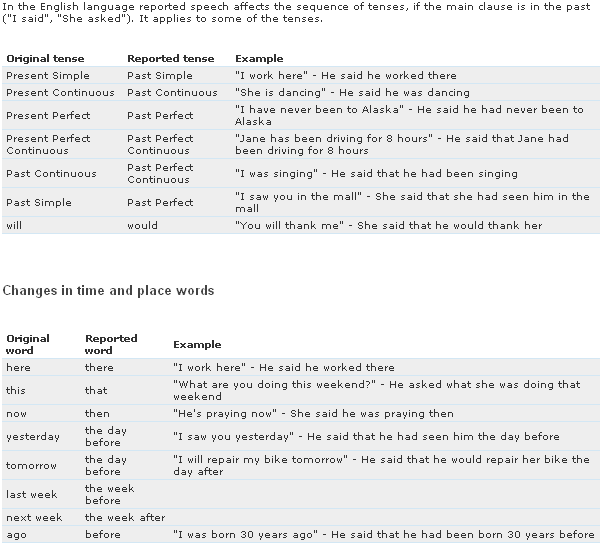
USE 3: Reported speech 
Use the Past Perfect with reposted speech.
Examples:
  • Mary said she had already seen this film.
  • He asked if I had read Harry Potter.
USE 4: Dissatisfaction with the past 
We often use the Past Perfect to show our dissatisfaction with the past. Such sentences typically start with "I wish ..." or "If only ...".
Examples:
  • I wish I had taken more food. I'm hungry now.
  • If only I had taken more food. I'm hungry now.
The Past Perfect is also used with expressions such as: "as if/though":
  • John looked as if he had done something terrible.
  • She looked as though she hadn't slept all night.
Form
To form a sentence in the Past Perfect, what you need is:
  1. The proper conjugation of the auxiliary verb "to have" in the past form.
  2. The Past Participle of your verb.
1. Auxiliary verb "to have"
The past form of the auxiliary verb "to have" is "had":
  • Mary had finished her homework before Mike came home.
  • Mary has finished her homework before Mike came home.
  • Mary hads finished her homework before Mike came home.
2. The Past Participle
The past participle of a verb is a verb form that appears with the perfect tenses. The past participle can be either regular or irregular.
  • The regular verbs are formed by adding -ed to the verb:
  • The formation of the irregular verbs does not follow one rule. Therefore, they should be memorized
Positive Sentences


Questions


Negative Sentences

Sunday, June 19, 2011

Past Perfect Continuous (Past Tenses)

The Past Perfect Continuous (Past Perfect Progressive) is used to talk about actions that began in the past and lasted up until another action in the past.
USE
  1. Duration of a past action up to a certain point in the past
  2. Third conditional sentences
  3. Reported speech
Note:Use 1 contains Use 3. This means that Use 1 is also valid in the sentences marked with Use 3.
The PPC is involved when the original tense is the Present Perfect Continuous or the Past Continuous.
"she has been crying" - she said she had been crying
"she was crying" - she said she had been crying

FORM
Declarative sentences:

  • I had been running for an hour when it started raining. (Use 1)
  • Mary said she had never been swimming so much in one day. (Use 3)
  • Kathy put on weight because she had been eating too much sugar. (Use 1)
  • Everything had been going well in my life until my world fell apart several months ago. (Use 1)

Questions:

  • For how many hours had Fred been painting the house when the ladder fell? (Use 1)
  • How long had the player been playing before he scored? (Use 1)
Negative sentences:

  • He said he wasn't tired because he hadn't been working that day. (Use 3)
  • If it hadn't been raining, we would have played football. (Use 2)
  • Had I not been studying all night, I would have problems with this test now. (Use 2)

Past Simple (Past Tenses)

EXAMPLE:
- I was sleepy.
- He didn't learn any Italian when he was in Italy two year ago.
- I went to the cinema, bought popcorn and watched a movie.
We use the Past Simple to talk about actions that happened at a specific time in the past. The actions can be short or long. There can be a few actions happening one ofter another.
USE 
  1. Events in the past that are now finished
  2. Situation in the past
  3. A series of actions in the past
USE 1: Past actions that are now finished
The first use of the Past Simple to express actions that happened at a specific time in the past. The actions can be short [1] or long [2].
Examples:
  • John cut his finger last week. [1]
  • I went to college 3 years ago. [2]
  • He ate the dinner 1 hour ago. [1]
  • I slept well last night. [2]
USE 2: Situation in the past
Another use of this tense is talk about situations in the past.
Examples:
  • I lived in New York for 10 years (I don't live there anymore).
USE 3: A series of actions in the past
The Past Simple can also be used with a few actions in the past happening one after another.
Examples:
  • He entered a room, lit a cigarette and smiled at the guests.
Form
Forming a sentence in the Past Simple is easy. To form a declarative sentence, all you need is the subject of the sentence (e.g. I, you, he, a dog) and the past form of your verb (e.g. was, talked, swam). Questions and negative sentences are only a little more difficult, because they require an auxiliary verb.

Declarative Sentences

I saw two colorful fishes in the lake yesterday (Use 1)


Time Expressions
Common time expressions (time adverbials) in the Past Simple are:
  • yesterday
  • the other day
  • just now
  • the day before yesterday
Questions


Negative Sentences