Sunday, June 19, 2011

Past Perfect Continuous (Past Tenses)

The Past Perfect Continuous (Past Perfect Progressive) is used to talk about actions that began in the past and lasted up until another action in the past.
USE
  1. Duration of a past action up to a certain point in the past
  2. Third conditional sentences
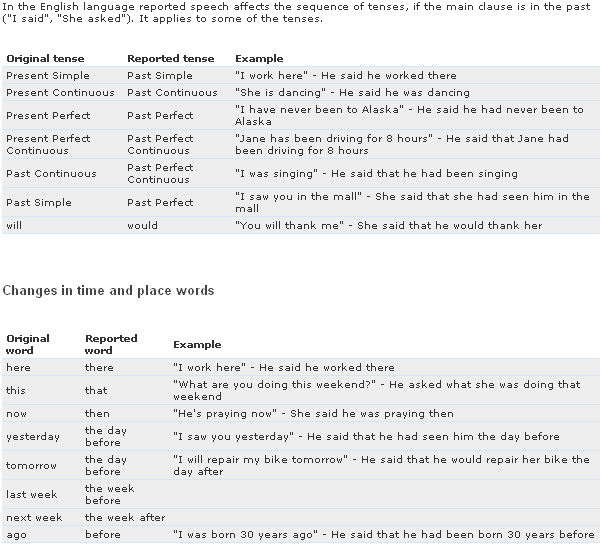
  3. Reported speech
Note:Use 1 contains Use 3. This means that Use 1 is also valid in the sentences marked with Use 3.
The PPC is involved when the original tense is the Present Perfect Continuous or the Past Continuous.
"she has been crying" - she said she had been crying
"she was crying" - she said she had been crying
FORM
Declarative sentences:

  • I had been running for an hour when it started raining. (Use 1)
  • Mary said she had never been swimming so much in one day. (Use 3)
  • Kathy put on weight because she had been eating too much sugar. (Use 1)
  • Everything had been going well in my life until my world fell apart several months ago. (Use 1)

Questions:

  • For how many hours had Fred been painting the house when the ladder fell? (Use 1)
  • How long had the player been playing before he scored? (Use 1)
Negative sentences:

  • He said he wasn't tired because he hadn't been working that day. (Use 3)
  • If it hadn't been raining, we would have played football. (Use 2)
  • Had I not been studying all night, I would have problems with this test now. (Use 2)

Past Simple (Past Tenses)

EXAMPLE:
- I was sleepy.
- He didn't learn any Italian when he was in Italy two year ago.
- I went to the cinema, bought popcorn and watched a movie.
We use the Past Simple to talk about actions that happened at a specific time in the past. The actions can be short or long. There can be a few actions happening one ofter another.
USE 
  1. Events in the past that are now finished
  2. Situation in the past
  3. A series of actions in the past
USE 1: Past actions that are now finished
The first use of the Past Simple to express actions that happened at a specific time in the past. The actions can be short [1] or long [2].
Examples:
  • John cut his finger last week. [1]
  • I went to college 3 years ago. [2]
  • He ate the dinner 1 hour ago. [1]
  • I slept well last night. [2]
USE 2: Situation in the past
Another use of this tense is talk about situations in the past.
Examples:
  • I lived in New York for 10 years (I don't live there anymore).
USE 3: A series of actions in the past
The Past Simple can also be used with a few actions in the past happening one after another.
Examples:
  • He entered a room, lit a cigarette and smiled at the guests.
Form
Forming a sentence in the Past Simple is easy. To form a declarative sentence, all you need is the subject of the sentence (e.g. I, you, he, a dog) and the past form of your verb (e.g. was, talked, swam). Questions and negative sentences are only a little more difficult, because they require an auxiliary verb.

Declarative Sentences

I saw two colorful fishes in the lake yesterday (Use 1)


Time Expressions
Common time expressions (time adverbials) in the Past Simple are:
  • yesterday
  • the other day
  • just now
  • the day before yesterday
Questions


Negative Sentences


Future Simple (Future Tenses)

EXAPLE:
  • I will clean up my room. I promise!
  • The telephone is ringing. I will pick it up!
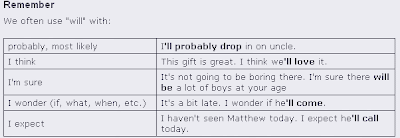
  • I think it will rain.
  • He will stay there for hours, doing nothing.
The Future Simple is used in many situations such as when making promises or predictions.

USE:
  1. Promises
  2. Unplanned actions (spontaneous decisions)
  3. Predictions based on experience or intuition
  4. Habits (obstinate insistence, usually habitual)
USE 1: Promises The first use of the Future Simple to make promises.
Examples:
- I promise I will buy you this toy.
- Promise you will never leave me!

USE 2: Unplanned actions (spontaneous decisions) Use this tense also to talk about unplanned (spontaneous) decisions.
Examples:
- Don't worry! I will help you with this problem.
- I will close the window. It's starting to rain.

USE 3: Predictions based on experience or intuition We often use the Future Simple when making a prediction based on experience or intuition.
Examples:
- It will rain in a moment.
- It will get more difficult.

USE 4: Habits The last use of this tense is interesting: we can also use the Future Simple to express habits.
Examples:
- She will bit her lip if she is thinking or if she's nervous about something.
- He will always make noise when we are sleeping.

Form
Contracted forms 
WILL = 'LL
She'll dance = she will dance
WILL + NOT = WON'T
She won't dance = she will not dance

Declarative Sentences

  • I think he will regret his choice. (Use 3)
  • I will come back at 10 p.m. (Use 1)
  • If you will keep your watch half an hour slow it is hardly surprising that you are late for your appointments. (Use 4)
  • John will keep dropping his towel on the floor after a bath. (Use 4)
  • I will visit my grandma at hospital. (Use 1 or Use 2)
  • Let's buy the snacks at the supermarket – they will be cheaper. (Use 3)
Question


  • Will he be surprised when he sees me? (Use 3)
  • Will Mark be able to do the shopping before 10 a.m.? (Use 3)
  • Will there be plenty of people in church? (Use 3)
  • Will you study harder? (Use 1)
Negative Sentences

  • I won't take any heavy equipment with me. (Use 2)
  • I'm sorry I won't be able to help you with your English today. (Use 2)
  • I expect that Sally will not clean up her room, unless you help her. (Use 3)